
Constructing Cat Habitats
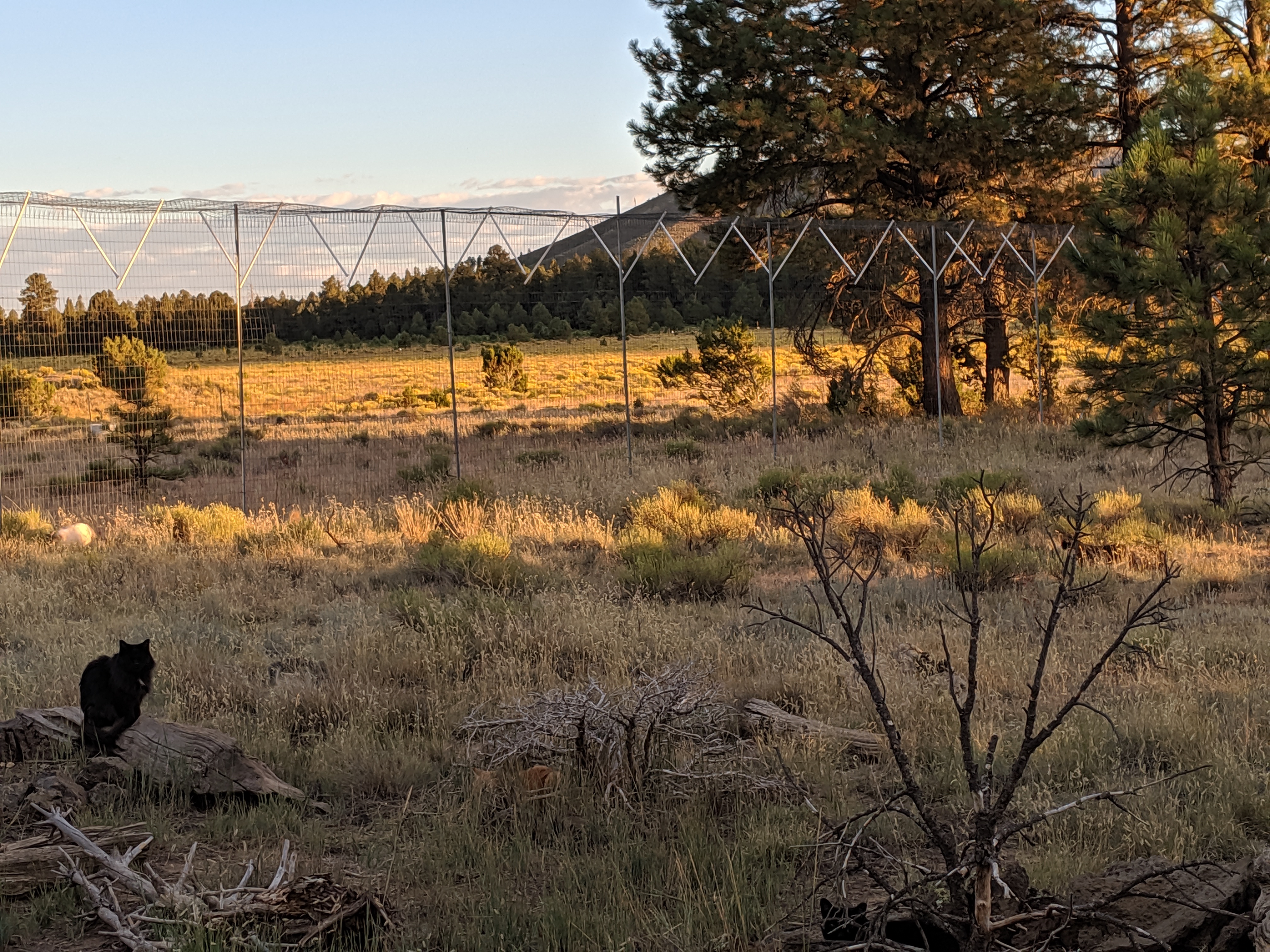
At the Ark Cat Sanctuary, we care for many feral or semi-feral cats who live in small groups with other feral kitties in indoor/outdoor cat enclosures. These kitties have access to a warm, clean, dry home-like indoor space that has an attached outdoor “habitat.” The outdoor habitats are “cat-fenced” landscaped areas that provide climbing, hiding and lounging opportunities for the cats. We do live in coyote territory, and the habitats are an effective way to keep the cats safe while allowing them to live their best lives and enjoy the sunshine.
While some housecats are happy as clams spending their entire lives indoors (the safest option for cats) some housecats feel the call of the outdoors and will let themselves out whenever the opportunity presents itself- the safest option for these kitties is to provide a catio or to cat proof your backyard to allow them safe access to outdoor spaces.
How To Build A Safe Cat Enclosure
Any back yard or barnyard can be enclosed in a way that keeps cats safely contained at home while meeting the need for outdoor cat activity time. You will need the following materials for habitat construction:This methodology is less expensive and more effective and flexible in application than kit systems that are marketed as cat enclosures.
The eight-foot “T” posts are driven into the ground to make six-foot verticals to support the six-foot field fence. Space the posts about 10 feet apart.
The top of the fence is horizontally capped using the four-foot field fencing.
The outermost two grids (eight inches) of the 4’ material are bent 90 degrees to give some rigidity to the top. The 4’ wide material is attached to the top of the 6’ vertical using tie wire wound around both pieces every three to four feet to hold the horizontal cap in place.
Ten-foot lengths of ½-inch white PVC pipe are cut into three-foot sections and notched at the ends to function as lateral bracing elements to hold the 4’ cap material in a fixed horizontal position. The PVC braces are attached to the outer edge of the horizontal top and to a grid on the vertical fence that allows the cap to lie in a horizontal plane. The notched ends of the PVC pipes are wired to a grid section on the vertical and horizontal parts of the fence.
For the entrance gates to the enclosure, we use standard 6’ chain link gates mounted to a constructed pipe or wooden frame. The gate frame construction requires the assistance of a person with a little mechanical savvy.
The fence is simple enough for a non-mechanically inclined person to put up. It is a bit labor intensive, but the reward is a permanent safe place for your cats to enjoy.
The same basic idea can be adapted to already existing block walls or wooden fences (provided that they are at least 6’ high) by using right-angle brackets with a horizontal span of at least 1.5 feet spaced four to five feet apart along the length of the fence to support the welded wire top grid that contains the cats.
Our enclosures at the sanctuary vary in size from 800 sq. ft. to 6000 sq. ft. depending on the needs of any particular group of cats.